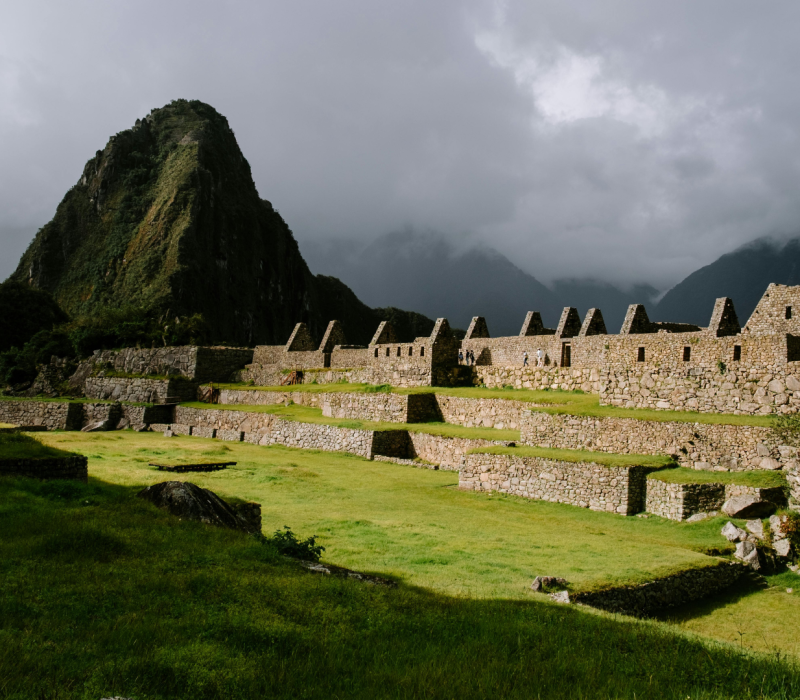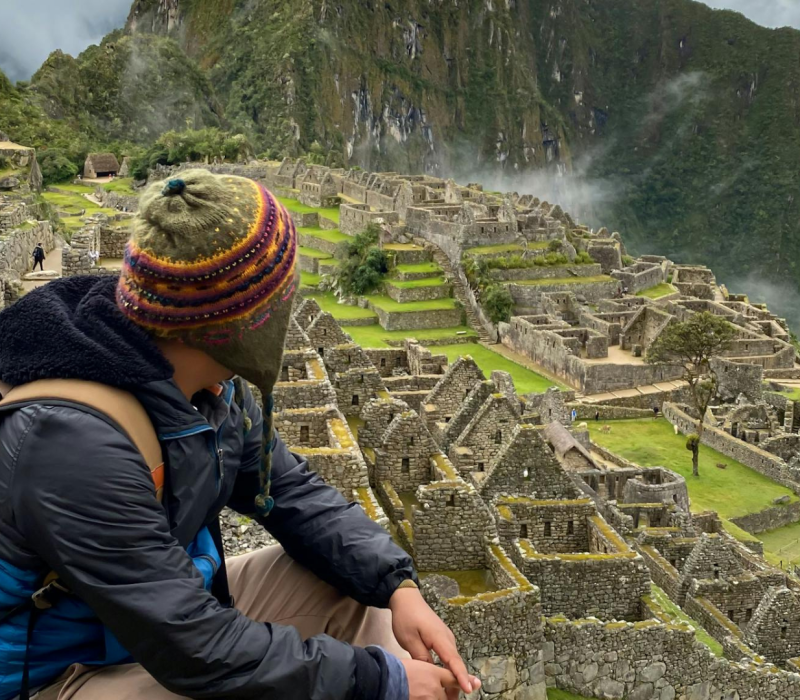


When one arrives at Machu Picchu, there is a question that appears almost by itself: why was it built right here? It doesn’t seem like the easiest place. It is located between steep mountains, surrounded by jungle and crossed by a river that cuts through the landscape with force. And yet, that is precisely the key. In this article, we are going to delve into the mysteries of the construction of Machu Picchu and what were the reasons why they were built in this place.
Why was Machu Picchu built in that location in the Andes?
Machu Picchu was not built at that point by chance. Its location responds to a combination of strategic, natural, spiritual and functional factors. The Incas did not choose their spaces at random. They observed the environment, understood the territory and built in harmony with it. That’s why Machu Picchu’s location is as impressive as its architecture.
1- It is a naturally protected environment
One of the first aspects that draws attention is its geographical position. Machu Picchu sits on a mountain ridge, surrounded by steep slopes and by the Urubamba River, which winds hundreds of meters below. From a natural point of view, it was a highly protected place.
This location made access difficult, which was an advantage. It was not necessary to build huge walls, because geography itself fulfilled a defensive function. The mountains, the slopes and the river acted as natural barriers that protected the site.
In addition, its relative isolation gave it a special character. It was not an open and exposed city, but a reserved space, which many researchers relate to a ceremonial center, a place of rest for the elite or a residence linked to the Inca nobility.
2- It is a place connected to the sacred
To understand why Machu Picchu is where it is, it is also necessary to understand how the Incas saw the world. For them, nature was not just the stage of everyday life: it was part of a sacred dimension.
The mountains, rivers, rocks and stars had a profound symbolic value. In that context, Machu Picchu’s location was not only convenient, it was also spiritual. The site is surrounded by mountains of great importance, such as Huayna Picchu and other Andean peaks, which were part of a vision of the world where the landscape had life and meaning.
From this perspective, Machu Picchu was not only a human settlement. It was also a space of connection between the earth, the sky and the forces of nature. Its location reinforced that relationship and made the place much deeper than a simple construction on the mountain.
3- A work that adapts to the landscape
Another key point is the way it was built. Unlike other civilizations that modified the terrain to impose their cities, the Incas used to do the opposite: they adapted their constructions to the natural environment.
In Machu Picchu that can be seen clearly. The terraces follow the slope of the mountain, the walls are integrated with the rocks and the buildings seem to be part of the landscape. There is a sense of balance between nature and engineering.
This is not only an aesthetic search. There is also a practical reason. The area where Machu Picchu is located receives abundant rainfall, so it was essential to have an efficient drainage system. And they succeeded. Below the city there is a complex structure that allows water to be filtered and channeled, preventing landslides and accumulations that could have damaged the buildings.
This ability to adapt shows that the place was chosen intelligently. The slope, the type of soil, the orientation and the natural conditions were used in favor of the project.
4- It was a strategic point within the Inca territory
Although Machu Picchu may seem like a remote place today, at the time it was part of a wide network of roads and connections in the Inca world. Its location was not only symbolic or defensive, it also had a strategic value.
It was located in a transition zone between the Andean highlands and the high jungle, which facilitated access to different resources, products and routes. This position made it possible to articulate diverse territories and take advantage of the best of various ecosystems.
For this reason, Machu Picchu should not be understood as a site isolated from the rest of the empire, but as an integrated piece within a much broader territorial vision. He was apart, yes, but at the same time connected.
The feat of building Machu Picchu in the middle of the mountains
One of the most impressive things about Machu Picchu is how it was built in such a challenging environment. There was no machinery, there was no modern technology, and yet they achieved a precision that continues to amaze to this day.
The Incas used a technique known as carved stone construction. Each block was worked to fit perfectly with the next, without the need to use mortar. This type of assembly was not only aesthetic, it also made the structures more resistant to seismic movements, something key in a region like the Andes. But the real genius is not only in what is seen. Underneath the city there is a complex structural base, composed of layers of stone and materials that allow rainwater to drain. It is estimated that a large part of the work is underground, avoiding leaks, accumulation of water and possible landslides.
In addition, the terrace system was not only used for agriculture. It also helped to stabilize the mountain and distribute the weight of the constructions. Each element fulfilled more than one function. All this shows that Machu Picchu was not built improvised. It was the result of planning, knowledge of the environment and highly developed engineering, designed to last.
The rediscovery of Machu Picchu
Although today it is one of the most well-known destinations in the world, for centuries Machu Picchu remained hidden from much of the outside world.
In 1911, the American explorer Hiram Bingham arrived in the area guided by local inhabitants. It was not exactly a “discovery” in the strict sense, since the communities of the region knew the place, but it was the moment when Machu Picchu began to be spread internationally.
Back then, the city was covered by vegetation. The jungle had advanced on the structures, partially hiding them and protecting them from the passage of time and possible looting. From that moment on, the cleaning, study and research work began. Over time, Machu Picchu went from being a virtually unknown site to becoming one of the most important icons of world heritage.
Today, Machu Picchu is recognized as one of the seven wonders of the modern world and receives visitors from all corners of the planet. Even so, that atmosphere of mystery, grandeur and wonder remains intact. On our tour to Machu Picchu by Observatory Train you will be able to learn these and many other curiosities about this extraordinary architectural treasure.
Are you interested in knowing what experiences you can do in Peru? Contact us and we will pass you access to Inka Planet Adventure to discover available tours and packages.